
I fondamenti dell’etica
Autori: G. Ghilardi per il capitolo NEUROETICA: TRA L’ETICA DELLE NEUROSCIENZE E LE NEUROSCIENZE DELL’ETICA, pp. 399-409
Curatori: I. Poma
Collana: Fondazione Centro Studi Filosofici di Gallarate
Editore: Morcelliana, Brescia, 2017
ISBN: 9788837230562
Il titolo del volume che raccoglie gli Atti del 60° Convegno di Ricerca Filosofica – I fondamenti dell’etica – segnala l’urgenza del pensare all’etica, oggi. A fronte della crisi in cui versa la riflessione morale e del tono minore in cui è tenuto il riferimento etico, si rende necessario tornare a riflettere su quanto rende possibile l’etica stessa. In questo ritorno alle fonti l’ambito etico scorre dal sostantivo al verbo dell’azione libera, e dal singolare del fondamento a un plurale che non relativizza, ma che relaziona e declina i modi di un senso che rinasce continuamente nei gesti liberi che ne testimoniano: il riconoscimento, la responsabilità, la fedeltà, l’ospitalità, il rispetto, con cui rispondiamo a ciò che riteniamo estremamente prezioso e che però ha bisogno anche del nostro impegno per potersi realizzare. Il discorso etico si anima nel dialogo tra universale e particolare, tra ideale e reale, tra infinito e finito: questo perché il più concreto e il più trascendente è il bene.
Le relazioni che aprono il volume offrono un approccio tematico al discorso etico secondo una categoria significativa che ne sonda terreno e profondità (il desiderio, la differenza, il rapporto con l’esperienza); i contributi che seguono si dispongono secondo l’ampio raggio tratteggiato dai riferimenti agli autori e ai problemi a cui i giovani ricercatori stanno dedicando i loro progetti di dottorato e di studio.
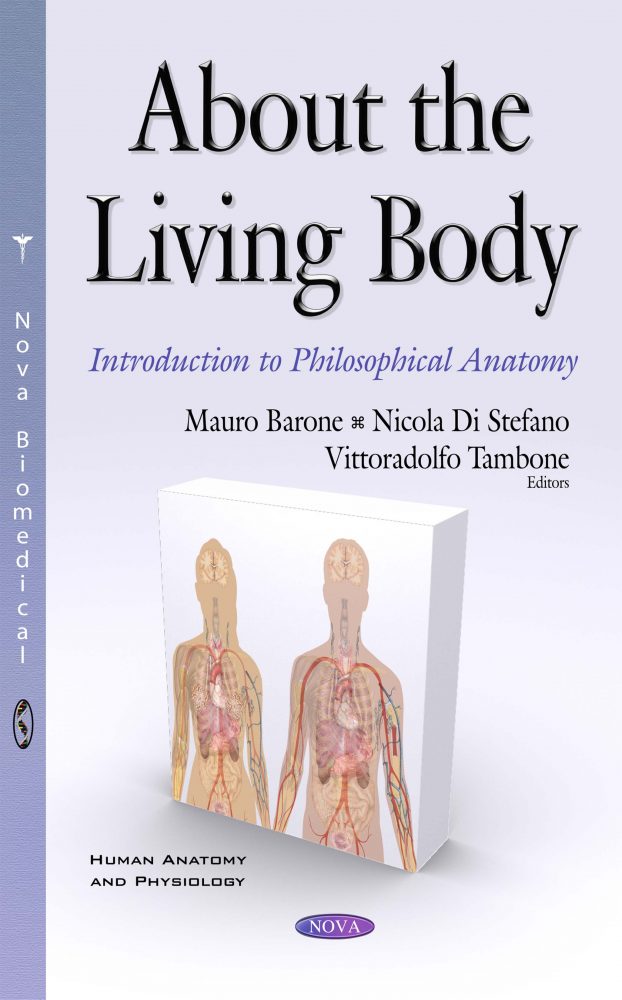
About the Living Body
Introduction to Philosophical Anatomy
Autori: G. Ghilardi per il capitolo ANALOGIA SENSUUM: THE KNOWING BODY, pp. 15-31
Curatori: M. Barone, N. Di Stefano, V. Tambone
Serie: Human Anatomy and Physiology
Editore: Nova Science Publishers, Incorporated, New York, 2016
ISBN: 9781634843577
The anatomical description of the human body outlines its morphology, answering mainly the question of “how it works”. Therefore, a detailed layout is displayed on the anatomical board, where every element is analyzed thoroughly. A description of the body as such does not trace the real body: the unity of the corporeal reality is closely connected with the entirety of the person, whose body is in the necessary condition to be able to carry out actions which are peculiar to it. As the reality of the body is to be an acting body, then a description that captures the real physical entity in its fullness must go through the acts that the subject does with his own body, which is always living a symbolic, intentional and emotional at lifestyle. In this volume, we present the first version of the “philosophical” anatomy of the body, which outlines through a survey the intentional acts of humans, or the true reality of man and his body. From this new perspective, the unity and entirety of the body are highlighted: the body is what a person has to feed, what makes someone play sports and music, dance, pray, work, and what allows me to carry out all those actions which make someone feel realized as a person. This new conceptual approach brings us on a phenomenological level when describing this data, and thus the acts of the living body. A new perspective, from which the corporeality takes shape as a living entity, and not as a set of substance and accidents, or an aggregate of organs, or a transcendent spiritual unity.

L’ umanizzazione della medicina globalizzata
Autori: G. Ghilardi, V. Tambone per il capitolo FILOSOFIA E DEONTOLOGIA DELL’AGIRE MEDICO-SCIENTIFICO, LA MEDICINA CHE VORREI, pp. 15-28
Curatori: S. Filetti, S. Morini
Collana: Nuovo Umanesimo/6
Editore: Libreria Editrice Vaticana, Roma, 2015
ISBN: 9788820996284
 Giampaolo Ghilardi